AI and Enforcement: What the Numbers Really Tell Us.
Insights from CIVEA Conference 2026
At the recent CIVEA Conference Amy Collins, CIVEA President and Managing Director of Rundles, asked the audience three simple questions about AI. Their answers painted a picture that may be familiar to many organisations right now: a workforce that is engaging with AI in meaningful numbers and cautiously optimistic about their own ability to use it but quietly sceptical about whether it will actually solve the problems that matter most.
People are using AI, but the picture is polarised
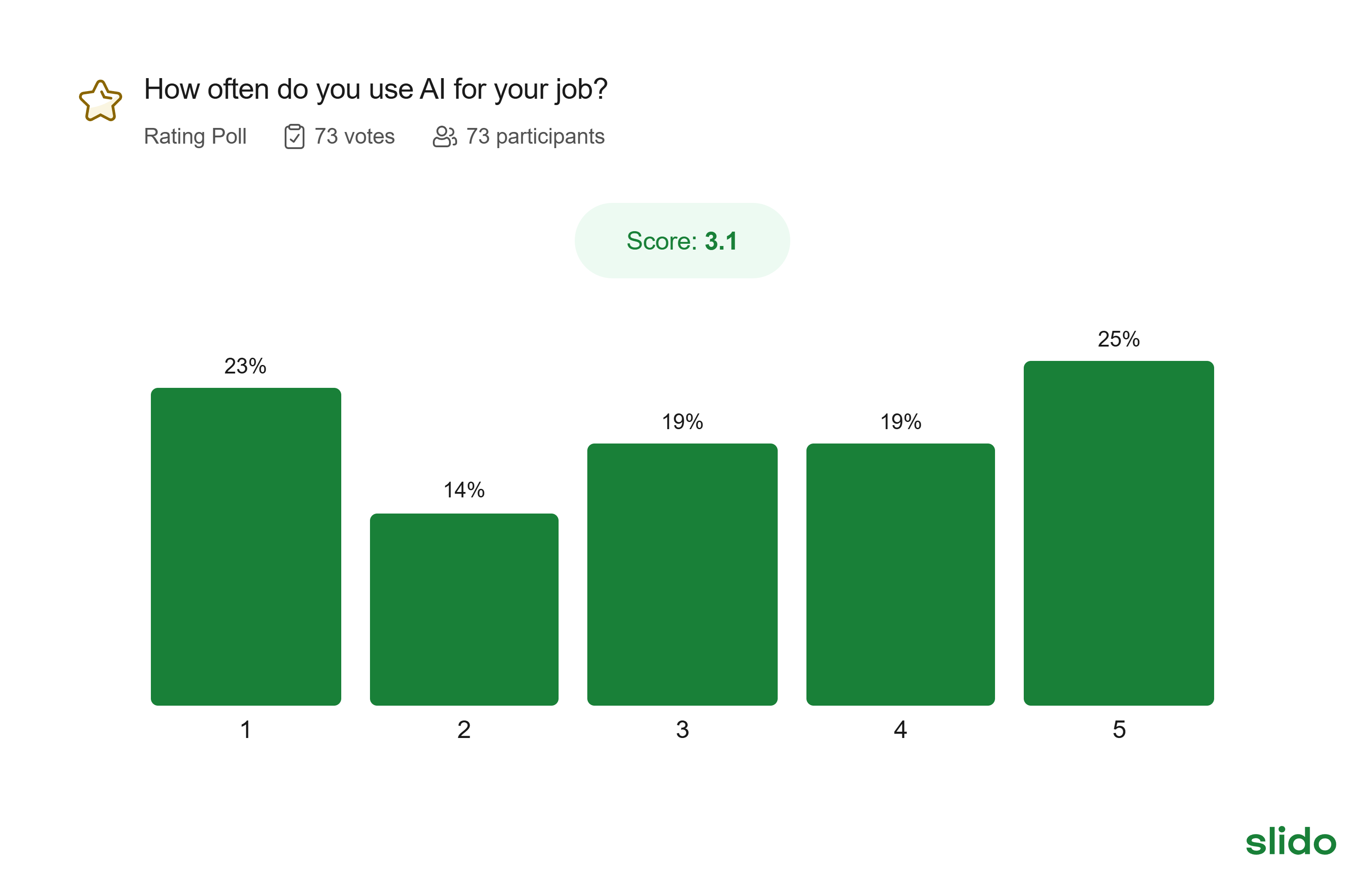
When asked how often they use AI for their job, the responses were striking for their spread. A quarter of delegates rated themselves at 5 (the highest frequency), yet almost as many, 23%, rated themselves at 1, meaning they barely use it at all. The middle ground was thin, with just 14% sitting at level 2. This wasn't a room of cautious non-adopters gradually warming to a new tool. It was a room split between enthusiastic regular users and people who haven't yet found a foothold. With an average score of 3.1 out of 5, the headline figure flatters what is actually a deeply divided picture.
Confidence in using AI is growing, but uncertainty remains the majority view
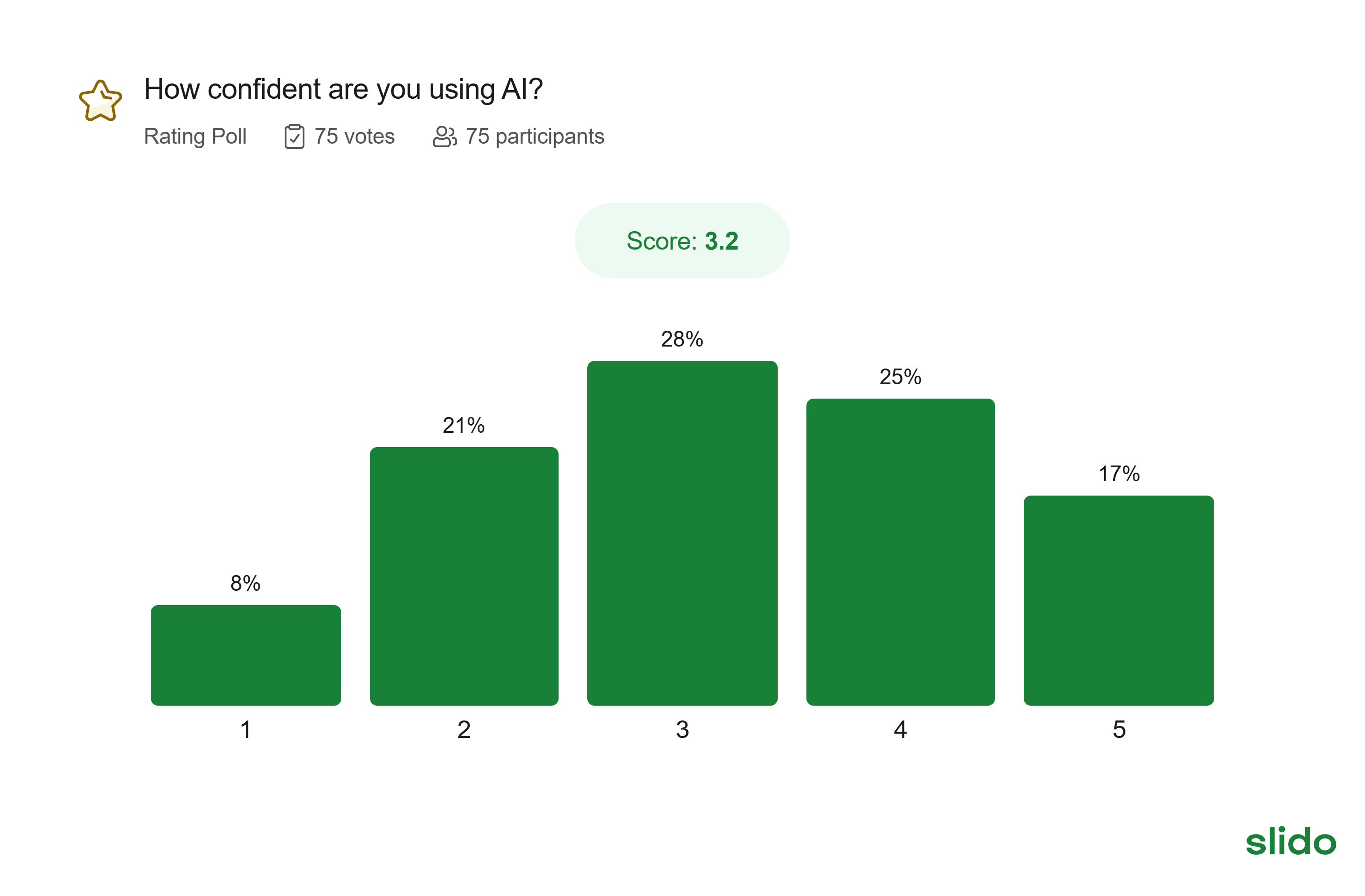
On the question of personal confidence using AI, the average score rose slightly to 3.2, and the distribution was noticeably healthier. Only 8% rated their confidence at 1, and the scores spread more evenly across the range, with 28% at 3, 25% at 4, and 17% at 5. Taken together, 42% of delegates placed themselves in the confident-to-very-confident camp (scores 4 and 5). That's a meaningful proportion, but it also means the majority still sit at 3 or below, suggesting that for most people, confidence remains a work in progress rather than an established reality.
Belief that AI will solve organisational problems? Much harder to find…
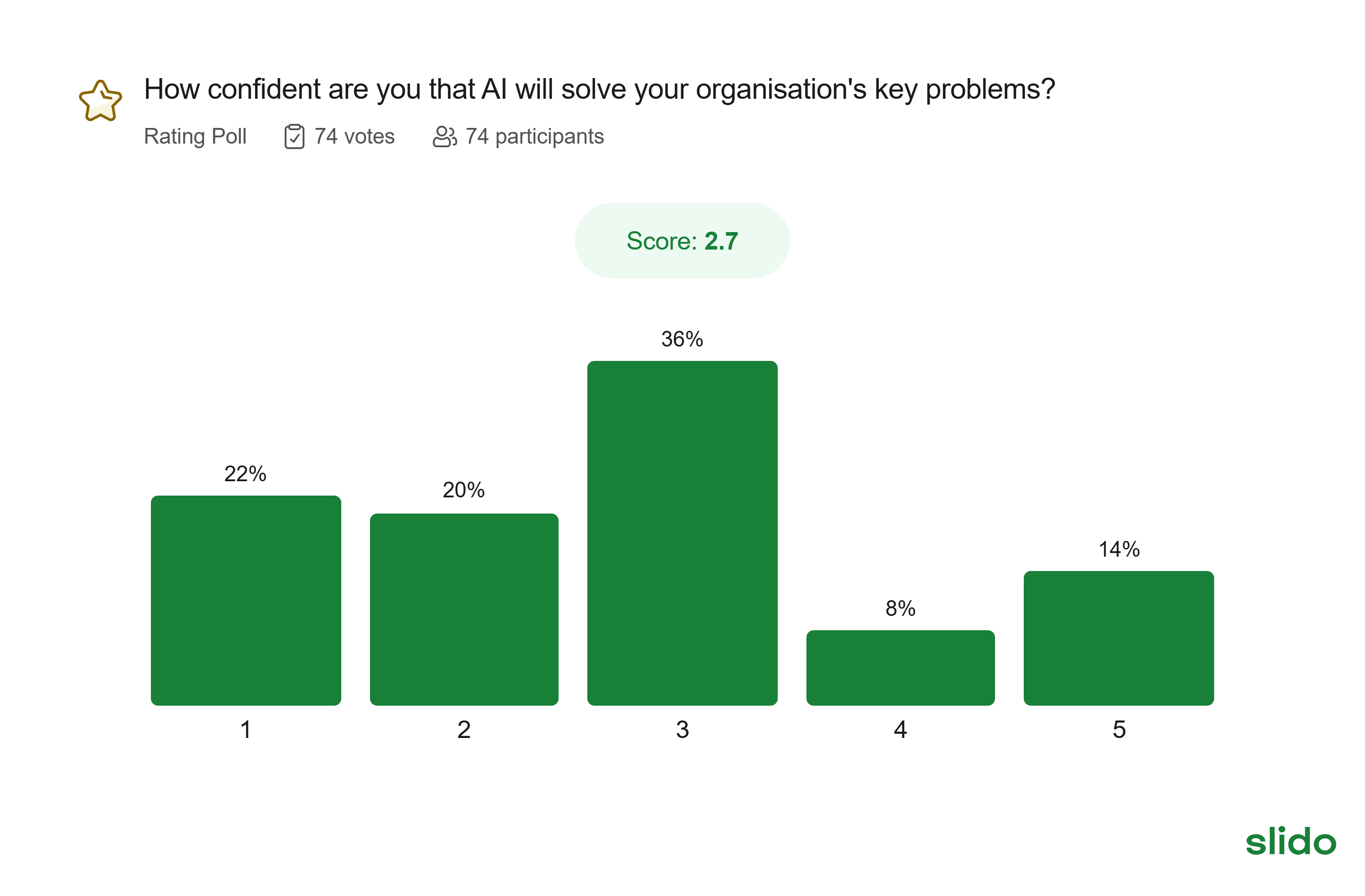
This is where the data becomes most interesting and most honest. Asked how confident they were that AI would solve their organisation's key problems, the average score dropped to 2.7, the lowest of the three questions. More than four in ten delegates (42%) rated their confidence at just 1 or 2. Only 22% felt genuinely confident, rating themselves 4 or 5. The modal response, the single most common answer, was 3, chosen by 36% of respondents: a diplomatic middle ground that often signals "I want to believe it, but I'm not convinced yet."
What this tells us
The gap between these three scores is the real story. People are using AI (3.1), they're building confidence in how to use it (3.2), but they're not yet persuaded it will move the needle on the things that actually matter to their organisations (2.7). This is a healthy and rational position. Enthusiasm for a tool is not the same as confidence in its outcomes, and a room full of enforcement and compliance professionals is unlikely to be swayed by hype alone.
Amy Collins said: "What strikes me most about these findings is not the scepticism, it's the engagement. Our members are using AI, they're building confidence, and they're asking the right questions. That's exactly the foundation we need. The next step is turning that curiosity into demonstrable results -not just through technology itself, but through how it supports the people using it and improves real-world outcomes for the organisations and communities we serve.”
The implication for organisations is clear: investment in AI tools needs to be matched by investment in demonstrating real-world impact. Training builds personal confidence. Proof builds organisational belief. Right now, the sector has made a reasonable start on the former and has significant work still to do on the latter.
Based on live polling of approximately 74–75 delegates at the CIVEA Conference.
For general enquiries only, you can contact us by email at info@civea.co.uk.
CIVEA is unable to consider complaints about its members. If you have a complaint or concern about one of our members, please go to our complaints page for more information.